Numpy in Python
NumPy (Numerical Python) is an open-source Python library used for numerical and scientific computing. It provides support for large multi-dimensional arrays and matrices, along with a collection of high-level mathematical functions to perform operations on these arrays efficiently. NumPy serves as the foundation for many other Python libraries in data science, machine learning, and AI because it allows fast and efficient computation on large datasets.
The library is highly optimized for performance, enabling element-wise operations, linear algebra, statistical computations, and broadcasting of arrays. Its core data structure, the ndarray (N-dimensional array), allows storing homogeneous data types and performing complex mathematical operations efficiently, both on CPUs and GPUs when integrated with other libraries.
In essence, NumPy transforms Python into a powerful tool for numerical analysis and scientific computing, making it indispensable for AI, machine learning, and data-driven applications.
Importance of NumPy in Python Data Analysis
NumPy, short for Numerical Python, is a fundamental library for numerical computing in Python. It provides high-performance multidimensional arrays, matrices, and a collection of mathematical functions, forming the backbone for many other Python data analysis and scientific libraries. Its importance lies in enabling analysts, researchers, and developers to perform fast, efficient, and precise numerical computations that are essential for data manipulation, modeling, and analysis.
1. Efficient Handling of Large Datasets
NumPy is designed to handle large-scale numerical data efficiently. Unlike Python lists, NumPy arrays use contiguous memory allocation, which allows for faster computation and reduced memory usage. This makes NumPy essential for processing datasets that are too large or too complex for standard Python data structures, enabling analysts to perform operations like matrix multiplication, statistical computation, and linear algebra quickly and efficiently.
2. High-Performance Mathematical Operations
NumPy provides a comprehensive suite of mathematical and statistical functions that operate directly on arrays and matrices. These include trigonometric functions, logarithms, exponential functions, and basic arithmetic operations. Its vectorized operations eliminate the need for slow Python loops, making computations much faster. This performance advantage is critical in fields like data analysis, machine learning, scientific computing, and engineering applications.
3. Foundation for Other Python Libraries
NumPy serves as the foundation for many other Python libraries used in data analysis, scientific computing, and machine learning. Libraries such as Pandas, SciPy, Matplotlib, Scikit-learn, TensorFlow, and PyTorch rely heavily on NumPy arrays for efficient data storage and numerical operations. Its core functionalities ensure that these libraries can perform high-speed calculations, manipulations, and integrations seamlessly, making NumPy indispensable for any Python-based analytics workflow.
4. Support for Multidimensional Data Structures
NumPy allows the creation and manipulation of n-dimensional arrays (ndarrays), which are essential for representing complex data such as images, time series, matrices, and tensors. These multidimensional arrays enable analysts to perform element-wise operations, slicing, reshaping, and broadcasting effectively. This flexibility allows NumPy to handle a wide range of data types and structures, making it ideal for applications in machine learning, scientific research, and data visualization.
5. Integration with Mathematical and Statistical Tools
NumPy seamlessly integrates with Python’s mathematical and statistical libraries, allowing analysts to perform advanced computations with ease. Functions for linear algebra, Fourier transforms, random number generation, and statistical analysis are all efficiently implemented in NumPy. This integration allows users to combine numerical computation with predictive modeling, data processing, and visualization in a unified workflow, increasing productivity and analytical capability.
6. Facilitating Vectorization and Broadcasting
NumPy supports vectorization and broadcasting, which enable operations on entire arrays without writing explicit loops. This feature reduces code complexity, improves computational efficiency, and prevents errors that may arise from manual iteration. For example, adding two arrays element-wise or multiplying an array by a scalar can be performed instantly on large datasets, which is crucial for machine learning, image processing, and numerical simulations.
7. Portability and Scalability
NumPy is highly portable and can run on various platforms and operating systems. It can handle large datasets that scale efficiently without significant performance degradation. This scalability makes NumPy suitable for both small-scale research projects and enterprise-level data analysis pipelines, allowing organizations to work with diverse datasets efficiently and consistently.
NumPy’s importance in Python data analysis stems from its ability to provide high-performance numerical computation, support for multidimensional arrays, integration with other libraries, vectorized operations, and scalability. Its functionalities form the core of Python’s scientific and analytical ecosystem, empowering analysts, data scientists, and researchers to process, analyze, and model large datasets efficiently and accurately, making it an indispensable tool for modern data-driven applications.
Uses of NumPy in Data Analysis
NumPy is a foundational library for numerical computation in Python, widely used in data analysis because of its high-performance arrays, efficient computation, and integration with other analytical tools. Its capabilities allow analysts to manipulate, process, and analyze data quickly and accurately, making it essential in modern data-driven workflows.
1. Efficient Data Storage and Manipulation
NumPy allows analysts to store and manipulate large datasets efficiently using its n-dimensional array (ndarray) structure. These arrays support fast indexing, slicing, reshaping, and element-wise operations, making it easier to clean and organize raw data. Unlike standard Python lists, NumPy arrays provide better memory usage and computational speed, which is critical when handling massive datasets in business, research, or scientific applications.
2. Performing Mathematical and Statistical Calculations
NumPy provides a wide range of mathematical and statistical functions that can be applied directly to arrays. Analysts use NumPy for mean, median, standard deviation, correlation, linear algebra, and other computations on datasets. These capabilities allow for quick calculation of important metrics, helping in data summarization, feature engineering, and pattern recognition, which are essential for informed decision-making.
3. Data Cleaning and Preprocessing
NumPy is widely used in preprocessing data for analysis or machine learning tasks. It allows users to handle missing values, normalize or standardize datasets, and perform transformations efficiently. Vectorized operations in NumPy reduce manual looping, ensuring that preprocessing is both faster and less error-prone, which improves the quality and reliability of subsequent analysis.
4. Integration with Other Python Libraries
NumPy serves as the foundation for other key data analysis libraries such as Pandas, SciPy, Scikit-learn, Matplotlib, and TensorFlow. Data stored in NumPy arrays can be seamlessly passed to these libraries for further analysis, visualization, or predictive modeling, making NumPy a critical component in end-to-end data analysis workflows.
5. Support for High-Performance Computation
NumPy enables vectorized operations and broadcasting, allowing mathematical operations on entire datasets without explicit loops. This feature significantly reduces computation time for large datasets, enabling analysts to perform calculations efficiently. High-performance computation is essential in scenarios like real-time data processing, simulations, and predictive analytics where speed and accuracy are crucial.
6. Handling Multidimensional Data
NumPy’s ability to work with multidimensional arrays makes it ideal for complex datasets, including time series, images, and matrices. Analysts can perform reshaping, aggregation, and mathematical operations across different dimensions easily, which is important in fields like machine learning, computer vision, and scientific research where data is often multi-dimensional.
7. Data Visualization Support
NumPy is often used alongside visualization libraries like Matplotlib and Seaborn. Its arrays provide a structured and efficient data format for plotting, making it easier to visualize trends, distributions, and correlations. This support allows analysts to communicate insights effectively and identify patterns visually, which is critical in both business and research contexts.
8. Basis for Machine Learning and Predictive Modeling
NumPy plays a key role in building machine learning models by providing efficient data structures and computations required for feature engineering, model training, and evaluation. Its fast linear algebra operations, array manipulation, and mathematical functions allow analysts to prepare datasets and perform computations needed for regression, classification, clustering, and neural network models.
NumPy’s uses in data analysis make it an indispensable tool for handling, processing, and analyzing numerical data efficiently. Its combination of fast computation, multidimensional array support, integration with other libraries, and mathematical functionality enables analysts and data scientists to transform raw data into actionable insights, power predictive modeling, and support decision-making across industries.
Key Features of NumPy
N-Dimensional Arrays (ndarray): At the heart of NumPy is the ndarray, a flexible n-dimensional container for homogeneous data. Unlike Python lists, which can hold elements of different types, an ndarray stores data of the same type in contiguous memory blocks. This allows for fast access, efficient computation, and easy manipulation of data across one or more dimensions. You can create 1D, 2D, or higher-dimensional arrays to represent vectors, matrices, or tensors.
Vectorized Operations: NumPy allows element-wise operations on arrays without explicitly writing loops, a concept known as vectorization. This makes mathematical operations faster and more efficient, as computations are performed at the low-level C implementation of NumPy. For example, adding two arrays, multiplying elements, or applying functions to all elements can be done in a single statement, avoiding slow Python loops.
Mathematical Functions: NumPy provides a vast collection of mathematical functions for numerical computation. These include basic operations such as addition, subtraction, multiplication, and division, as well as advanced functions like exponential, logarithmic, trigonometric, statistical (mean, median, variance, standard deviation), and more. These functions are optimized to work efficiently on arrays of any dimension.
Random Number Generation: NumPy includes a random module to generate random numbers, arrays, and samples from various probability distributions. This is particularly useful for simulations, stochastic modeling, random sampling, and initializing weights in machine learning algorithms.
Linear Algebra: NumPy contains a robust set of linear algebra operations. It supports matrix multiplication, matrix inversion, determinant calculation, eigenvalues and eigenvectors, solving linear systems, and decomposition methods like LU or QR decomposition. These tools are essential in scientific computing, physics, engineering, and data science.
Integration with Other Libraries: NumPy arrays serve as the foundation for many other Python libraries. They integrate seamlessly with Pandas for data analysis, SciPy for scientific computing, Matplotlib for visualization, TensorFlow and PyTorch for machine learning, and OpenCV for computer vision. This compatibility allows for efficient data sharing and manipulation across multiple libraries without unnecessary conversions.
Memory Efficiency: Unlike Python lists, NumPy arrays are stored in contiguous memory blocks, which reduces overhead and improves cache performance. This memory-efficient structure allows handling of large datasets that may not fit comfortably into standard Python lists.
Broadcasting: NumPy supports broadcasting, a mechanism that allows operations between arrays of different shapes by automatically expanding their dimensions. This avoids explicit replication of data and allows concise, readable code for complex operations.
High Performance: NumPy is implemented in C and Fortran under the hood, which makes it much faster for numerical operations compared to native Python constructs. This high performance is critical in applications like large-scale simulations, real-time data processing, and deep learning.
Creating NumPy arrays
NumPy arrays can be created in multiple ways:
From Python lists or tuples
import numpy as np
arr = np.array([1, 2, 3, 4])
Using built-in functions
zeros = np.zeros((2, 3)) # 2x3 array of zeros
ones = np.ones((3, 2)) # 3x2 array of ones
range_arr = np.arange(0, 10, 2) # Array from 0 to 10 with step 2
linspace_arr = np.linspace(0, 1, 5) # 5 numbers evenly spaced between 0 and 1
Random Arrays
rand_arr = np.random.rand(3, 3) # 3x3 array of random numbers between 0 and 1
randint_arr = np.random.randint(0, 10, (2, 4)) # Random integers between 0 and 10
Array indexing and slicing
NumPy arrays can be accessed and manipulated like Python lists but with more powerful slicing.
arr = np.array([10, 20, 30, 40, 50])
print(arr[0]) # Access first element -> 10
print(arr[1:4]) # Slice from index 1 to 3 -> [20, 30, 40]
print(arr[-1]) # Last element -> 50
For multi-dimensional arrays:
arr2d = np.array([[1, 2, 3], [4, 5, 6]])
print(arr2d[0, 1]) # Element at first row, second column -> 2
print(arr2d[:, 1]) # All rows, second column -> [2, 5]
Array Operations
NumPy allows element-wise operations on arrays:
a = np.array([1, 2, 3])
b = np.array([4, 5, 6])
print(a + b) # [5, 7, 9]
print(a * b) # [4, 10, 18]
print(a - b) # [-3, -3, -3]
print(a / b) # [0.25, 0.4, 0.5]
You can also apply functions directly:
print(np.sqrt(a)) # [1.0, 1.414, 1.732]
print(np.mean(a)) # 2.0
Basic NumPy Operations
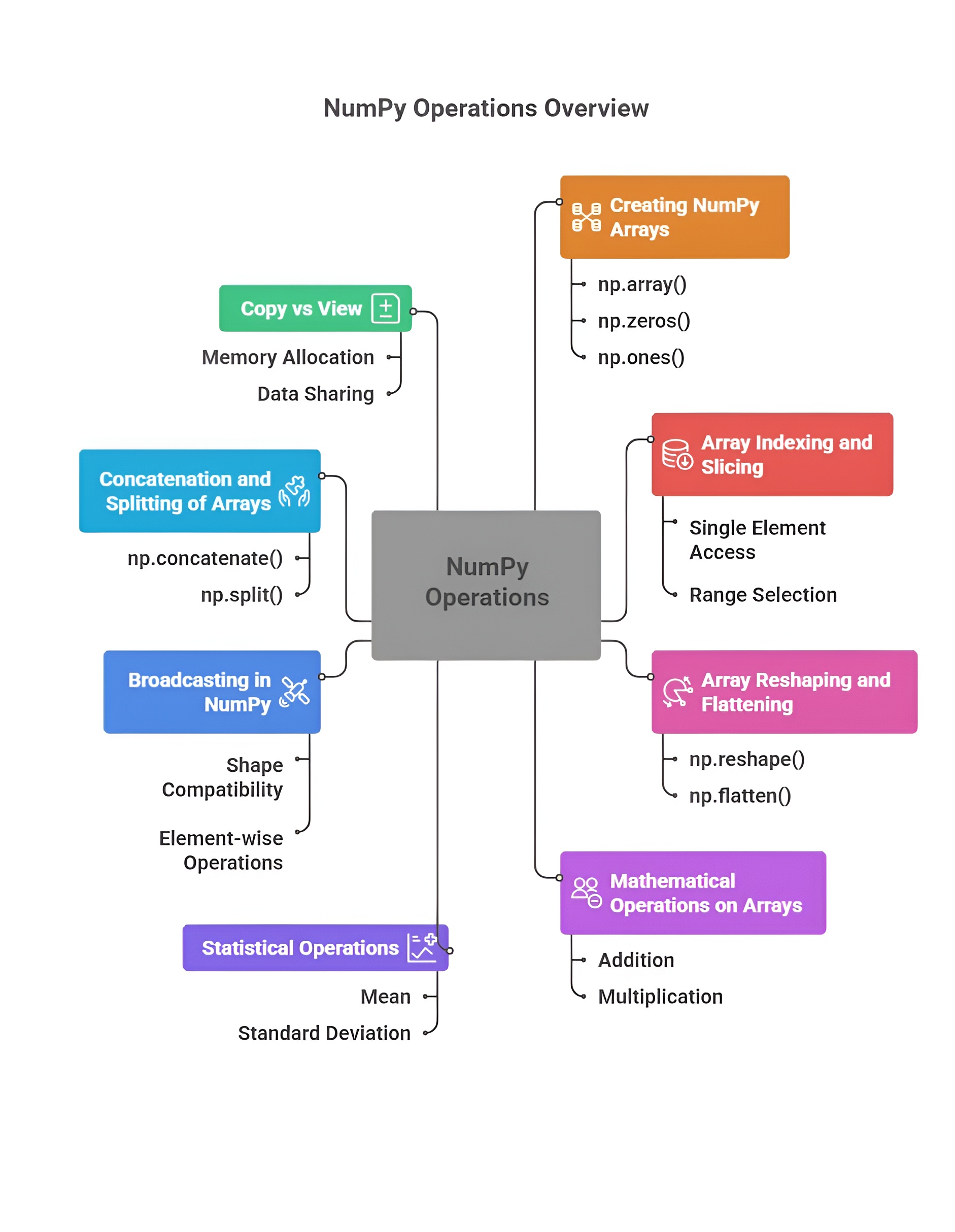
Basic NumPy operations involve performing fast and efficient calculations on arrays, such as addition, subtraction, multiplication, and division applied element-wise. These operations also include reshaping arrays, accessing specific elements or slices, and combining or splitting arrays as needed. NumPy makes mathematical tasks like finding means, sums, and maximum values simple and quick. With built-in vectorized functions, computations run faster than traditional loops. Overall, these operations form the core of working effectively with numerical data in Python.
1. Arithmetic Operations
Arithmetic operations in NumPy allow element-wise calculations on arrays. This means each element of one array is combined with the corresponding element of another array. NumPy also supports broadcasting, so arrays of different shapes can sometimes be combined automatically.
For example, if we have two arrays representing daily sales from two stores:
import numpy as np
store1 = np.array([100, 150, 200])
store2 = np.array([80, 120, 160])
total_sales = store1 + store2
print(total_sales) # Output: [180, 270, 360]
Here, the addition operation adds each element of store1 with the corresponding element of store2. Similarly, you can perform subtraction, multiplication, and division in an element-wise manner.
2. Statistical Operations
Statistical operations in NumPy provide summary measures of data, which are crucial for data analysis and understanding datasets. Functions like mean, median, std (standard deviation), min, and max allow users to quickly describe the distribution of numbers.
sales = np.array([100, 150, 200, 250, 300])
average_sales = np.mean(sales)
max_sales = np.max(sales)
std_dev = np.std(sales)
print(average_sales) # Output: 200.0
print(max_sales) # Output: 300
print(std_dev) # Output: 70.71067811865476
Here, mean calculates the average, max gives the highest sales, and std provides the spread of values around the mean.
3. Universal Functions (ufuncs)
Universal functions operate element-wise on arrays and are optimized for performance. They include mathematical operations like sqrt, exp, log, sin, and cos.
numbers = np.array([1, 4, 9, 16])
sqrt_values = np.sqrt(numbers)
exp_values = np.exp(numbers)
print(sqrt_values) # Output: [1. 2. 3. 4.]
print(exp_values) # Output: [2.71828183, 54.59815003, 8103.08392758, 8886110.52050787]
Here, sqrt calculates the square root of each element, and exp computes the exponential of each element. Using ufuncs avoids writing loops and is highly efficient for large datasets.
4. Aggregation Operations
Aggregation operations combine array elements into a single value or cumulative array. They are useful to get overall results like total, product, or cumulative sum.
profits = np.array([10, 20, 30, 40])
total_profit = np.sum(profits)
cumulative_profit = np.cumsum(profits)
print(total_profit) # Output: 100
print(cumulative_profit) # Output: [10, 30, 60, 100]
Here, sum gives the total profit, while cumsum shows the running total after each day.
5. Matrix Operations
NumPy provides linear algebra operations such as dot product, transpose, and inverse. These are important in machine learning, physics, and engineering.
A = np.array([[1, 2], [3, 4]])
B = np.array([[5, 6], [7, 8]])
dot_product = np.dot(A, B)
transpose_A = np.transpose(A)
print(dot_product)
# Output:
# [[19 22]
# [43 50]]
print(transpose_A)
# Output:
# [[1 3]
# [2 4]]
Here, dot performs matrix multiplication, and transpose flips rows and columns of the matrix.
6. Comparison and Logical Operations
NumPy supports element-wise comparisons and logical operations, which return Boolean arrays. This is useful for filtering and conditional selection.
ages = np.array([15, 20, 25, 30, 35])
adults = ages >= 18
print(adults) # Output: [False True True True True]
young_adults = (ages >= 18) & (ages <= 30)
print(young_adults) # Output: [False True True True False]
Here, the first condition checks who is 18 or older, and the second finds ages between 18 and 30.
7. Reshaping Arrays
Reshaping allows you to change the dimensions of an array without changing its data. This is essential when preparing data for machine learning models or mathematical computations.
arr = np.array([1, 2, 3, 4, 5, 6])
reshaped_arr = arr.reshape((2, 3)) # Convert to 2x3 array
print(reshaped_arr)
# Output:
# [[1 2 3]
# [4 5 6]]
Here, the one-dimensional array is reshaped into a two-dimensional array with 2 rows and 3 columns. Reshaping is especially useful when aligning data for matrix operations or neural networks.
8. Stacking Arrays
Stacking combines multiple arrays along an axis. There are vertical (vstack) and horizontal (hstack) stacking operations.
a = np.array([1, 2, 3])
b = np.array([4, 5, 6])
vertical_stack = np.vstack((a, b))
horizontal_stack = np.hstack((a, b))
print(vertical_stack)
# Output:
# [[1 2 3]
# [4 5 6]]
print(horizontal_stack)
# Output: [1 2 3 4 5 6]
Vertical stacking creates multiple rows, while horizontal stacking combines arrays in a single row.
9. Splitting Arrays
Splitting divides an array into multiple sub-arrays. This is useful when you want to process chunks of data separately.
arr = np.array([10, 20, 30, 40, 50, 60])
split_arr = np.array_split(arr, 3)
print(split_arr)
# Output: [array([10, 20]), array([30, 40]), array([50, 60])]
Here, the array is split into 3 equal (or nearly equal) parts. You can also split along rows or columns for 2D arrays.
10. Copying and Viewing Arrays
NumPy arrays can be copied or viewed. A view shares memory with the original array, so changes in the view affect the original array. A copy creates a new independent array.
arr = np.array([1, 2, 3])
view_arr = arr.view()
copy_arr = arr.copy()
view_arr[0] = 100
print(arr) # Output: [100 2 3] (original array changed)
print(copy_arr) # Output: [1 2 3] (copy unaffected)
Understanding views vs. copies is important for memory management and avoiding unintended changes.
11. Sorting Arrays
NumPy provides functions to sort arrays efficiently. You can sort 1D or multi-dimensional arrays.
arr = np.array([5, 2, 8, 1])
sorted_arr = np.sort(arr)
print(sorted_arr) # Output: [1 2 5 8]
For 2D arrays, you can sort along rows or columns:
arr2d = np.array([[3, 1], [2, 4]])
sorted_arr2d = np.sort(arr2d, axis=1)
print(sorted_arr2d)
# Output:
# [[1 3]
# [2 4]]
Sorting is useful for ranking, filtering, and statistical analysis.
12. Mathematical Set Operations
NumPy supports set-like operations on arrays, which are useful in data analysis and finding unique values or intersections.
a = np.array([1, 2, 3, 4])
b = np.array([3, 4, 5, 6])
union = np.union1d(a, b)
intersection = np.intersect1d(a, b)
difference = np.setdiff1d(a, b)
print("Union:", union) # [1 2 3 4 5 6]
print("Intersection:", intersection) # [3 4]
print("Difference:", difference) # [1 2]
These operations help compare datasets, find common elements, or remove duplicates efficiently.
13. Boolean Indexing and Filtering
Boolean indexing allows selecting elements that satisfy a condition. It’s highly useful for filtering large datasets.
arr = np.array([10, 20, 30, 40, 50])
filtered_arr = arr[arr > 25]
print(filtered_arr) # Output: [30 40 50]
Here, only the elements greater than 25 are extracted. Multiple conditions can also be combined using logical operators & (and), | (or), and ~ (not).
14. Transposing and Swapping Axes
For multi-dimensional arrays, you can transpose or swap axes, which is essential in linear algebra, machine learning, and image processing.
arr2d = np.array([[1, 2, 3], [4, 5, 6]])
transposed = arr2d.T
print(transposed)
# Output:
# [[1 4]
# [2 5]
# [3 6]]
Transposing flips rows and columns, and swapaxes can swap any two dimensions in higher-dimensional arrays.

Class Sessions
Sales Campaign

We have a sales campaign on our promoted courses and products. You can purchase 1 products at a discounted price up to 15% discount.