Introduction to Python
Python is a high-level, general-purpose, and open-source programming language designed to be extremely simple, readable, and developer-friendly. It is an interpreted, dynamically typed, and object-oriented language that emphasizes clarity of syntax, allowing programmers to write code that is easy to understand and maintain. Created with the philosophy that code should be as readable as English, Python supports multiple programming paradigms such as procedural programming, object-oriented programming, and functional programming. Due to its vast standard library, huge community support, and extensive ecosystem of frameworks and libraries, Python has become one of the most popular languages in the world, used for software development, data science, artificial intelligence, automation, cybersecurity, and numerous other domains. Its simplicity makes it ideal for beginners, while its power makes it suitable for complex, large-scale applications used by industry leaders like Google, Netflix, NASA, and Meta.
History & Evolution
The development of Python began in the late 1980s when Guido van Rossum, a Dutch programmer at the Centrum Wiskunde & Informatica (CWI) in the Netherlands, set out to create a language that was easy to learn yet powerful enough to solve real-world problems. Python’s first public version, Python 0.9.0, was released in 1991 and already included essential features such as functions, exception handling, and core data types. Python 1.0 was released in 1994 and introduced important programming concepts including lambda functions and modular programming. A major milestone came in 2000 with Python 2.0, which added list comprehensions, garbage collection, and Unicode support. Python continued to evolve, and in 2008, Python 3.0 was introduced as a cleaner and more modern version of the language. Although Python 3 was not backward compatible with Python 2, it offered superior performance, better Unicode handling, and a redesigned standard library. Python 2 reached its end of life in 2020, making Python 3 the only actively maintained version. Over time, Python has grown from a simple scripting language into a global standard for modern software development, research, and technological innovation.
Features of Python
Python is a high-level, interpreted programming language known for its simplicity and readability. It supports multiple programming paradigms, including procedural, object-oriented, and functional programming. Python’s versatile nature and extensive standard library make it ideal for a wide range of applications, from web development to data science.
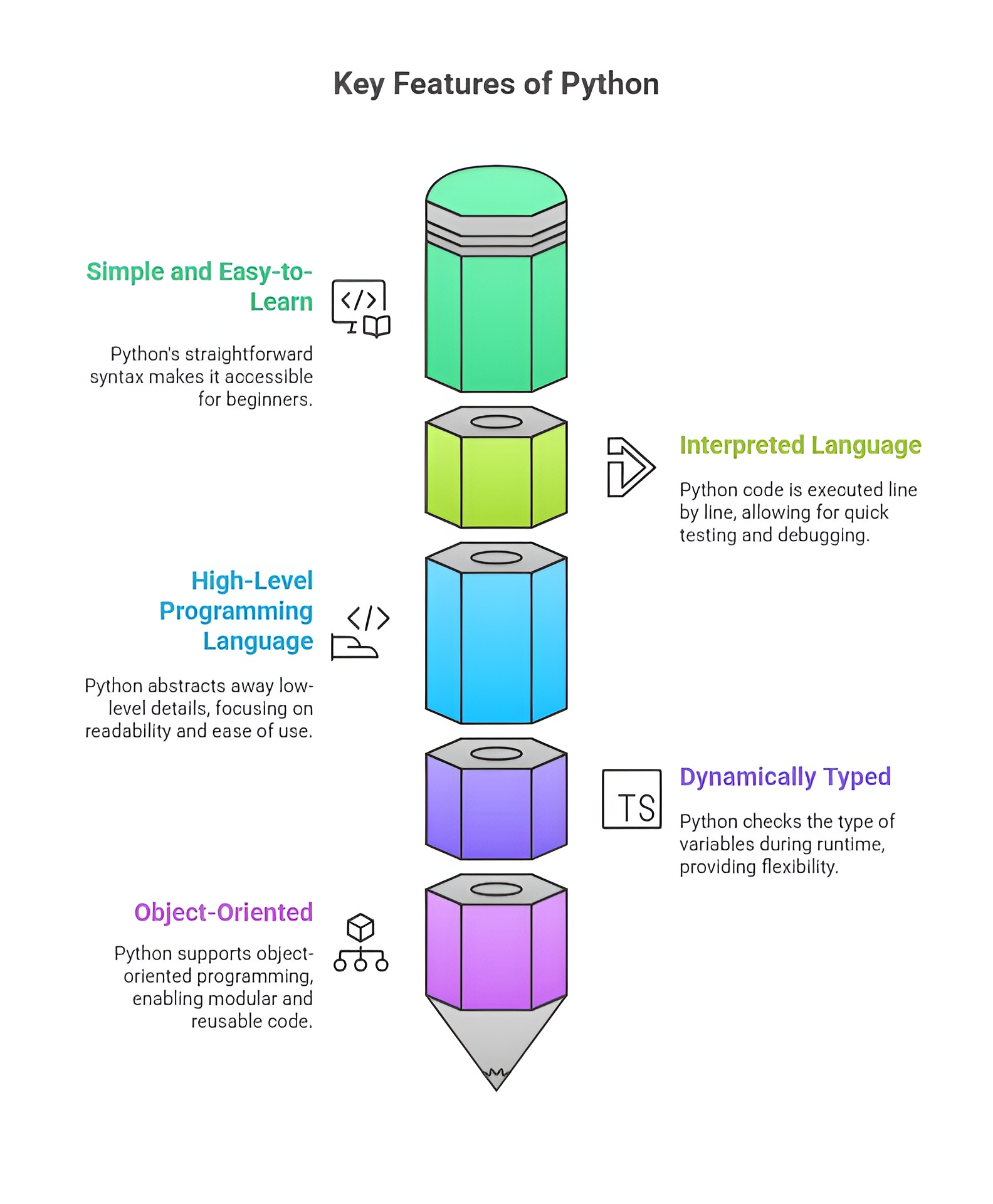
1. Simple and Easy-to-Learn
Python is known for its extremely simple and readable syntax, which makes it one of the best languages for beginners and professionals. Its syntax closely resembles English, reducing the learning curve and allowing developers to focus more on concepts rather than remembering complex rules. This simplicity also minimizes errors and helps in writing clean and maintainable code.
2. Interpreted Language
Python is an interpreted language, meaning its code is executed line-by-line by the Python interpreter. This feature simplifies debugging because errors are detected immediately during execution. It also eliminates the need for compiling the code beforehand, making the development cycle faster and more efficient.
3. High-Level Programming Language
As a high-level language, Python hides complex low-level details such as memory management, hardware interactions, and system-level operations. Developers do not need to manually allocate or free memory. This abstraction allows programmers to write programs faster with less effort while maintaining clarity and focus on solving real problems.
4. Dynamically Typed
Python does not require users to declare the data type of variables. The type is decided at runtime based on the assigned value. This dynamic typing allows flexibility in coding and reduces the amount of boilerplate code. It also supports automatic type changes, which makes Python expressive and adaptable.
5. Object-Oriented
Python fully supports object-oriented programming concepts like classes, objects, inheritance, polymorphism, and encapsulation. This feature enables developers to create reusable, modular, and organized code. Object-oriented programming makes Python great for building large and complex software applications.
6. Extensive Standard Library
Python comes with a vast built-in library known as the "Python Standard Library" that contains modules for file handling, regular expressions, networking, database operations, mathematics, web services, and more. This reduces the need for writing code from scratch and speeds up application development.
7. Cross-Platform Language
Python is platform-independent, meaning Python code written on one operating system can run on others—such as Windows, Linux, macOS, or Unix—without modification. This portability makes Python ideal for projects that require compatibility across different environments.
8. Large Community Support
Python has one of the largest and most active programming communities in the world. Developers can easily find solutions to problems, libraries for specific tasks, tutorials, and documentation. Community support ensures that Python continuously evolves and improves with time.
9. Rich Ecosystem of Libraries and Frameworks
Python’s huge ecosystem of third-party libraries and frameworks makes it extremely powerful. Libraries like NumPy, Pandas, and Matplotlib are used in data science, while TensorFlow and PyTorch are used in AI. Django and Flask support web development. This ecosystem extends Python’s capabilities far beyond a normal programming language.
10. Supports Multiple Programming Paradigms
Python supports procedural, object-oriented, and functional programming. This flexibility allows developers to choose the style that best fits the problem. It also encourages writing cleaner and more efficient code in various formats.
Applications of Python
Python is a versatile programming language widely used across different domains due to its simplicity and powerful libraries. It finds applications in web development, data analysis, artificial intelligence, automation, and more. Its adaptability makes it a preferred choice for both beginners and professional developers.
1. Web Development
Python is widely used for creating dynamic websites, backend APIs, and full-stack applications through powerful frameworks like Django, Flask, and FastAPI. These frameworks provide built-in security features, database handling, and scalable architectures, enabling developers to build modern web applications quickly and efficiently.
2. Data Science and Data Analysis
Python has become the most dominant language in data science due to its strong libraries like Pandas, NumPy, and Matplotlib. It is used for data cleaning, data exploration, statistical analysis, visualization, and reporting. Companies use Python to analyze user behavior, optimize systems, and make business decisions based on data insights.
3. Artificial Intelligence and Machine Learning
AI and ML heavily rely on Python due to its simplicity and powerful frameworks such as TensorFlow, Keras, Scikit-learn, and PyTorch. Python is used to build neural networks, prediction models, recommendation systems, image and speech recognition systems, chatbots, and natural language processing applications. Its role in AI is unmatched.
4. Automation and Scripting
Python is frequently used to automate repetitive tasks like file operations, data entry, testing, and report generation. With libraries such as Selenium, PyAutoGUI, and BeautifulSoup, Python can automate web browsing, scrape information from websites, and perform system-level automation. It is widely used in DevOps and IT operations.
5. Cybersecurity and Ethical Hacking
Cybersecurity professionals use Python to build tools for vulnerability scanning, malware analysis, network monitoring, and penetration testing. Libraries like Scapy, Nmap, and Requests allow the creation of customized scripts for ethical hacking and security analysis. Python’s speed and ease make it a top choice in security domains.
6. Software and Application Development
Python is used for developing desktop applications, scientific tools, command-line utilities, and GUI-based applications using libraries like Tkinter, PyQt, and Kivy. Its object-oriented approach helps create scalable and feature-rich software for different industries.
7. Scientific and Numerical Computing
Python is widely used in research fields such as physics, chemistry, astronomy, engineering, and biology. Libraries like SciPy, SymPy, and Jupyter Notebook help in numerical computation, symbolic mathematics, simulations, experiment modeling, and scientific data visualization.
8. Game Development
Game developers use Python for building small to medium-sized games using libraries like Pygame and Panda3D. Python is also used for writing scripts within large game engines to control behaviors, artificial intelligence of characters, and event handling in video games.
9. Finance and Banking Sector
Python plays a major role in financial industries for algorithmic trading, risk management, fraud detection, predictive analytics, and real-time stock market calculations. Its libraries allow financial analysts and economists to compute huge datasets with speed and accuracy.
10. Education and Learning
Python is the first programming language taught in many schools, colleges, and universities because of its simplicity and readability. It is used to teach fundamental programming concepts, data structures, and algorithmic thinking, making it the preferred language in academic environments.
Advantages of using Python in real world scenarios
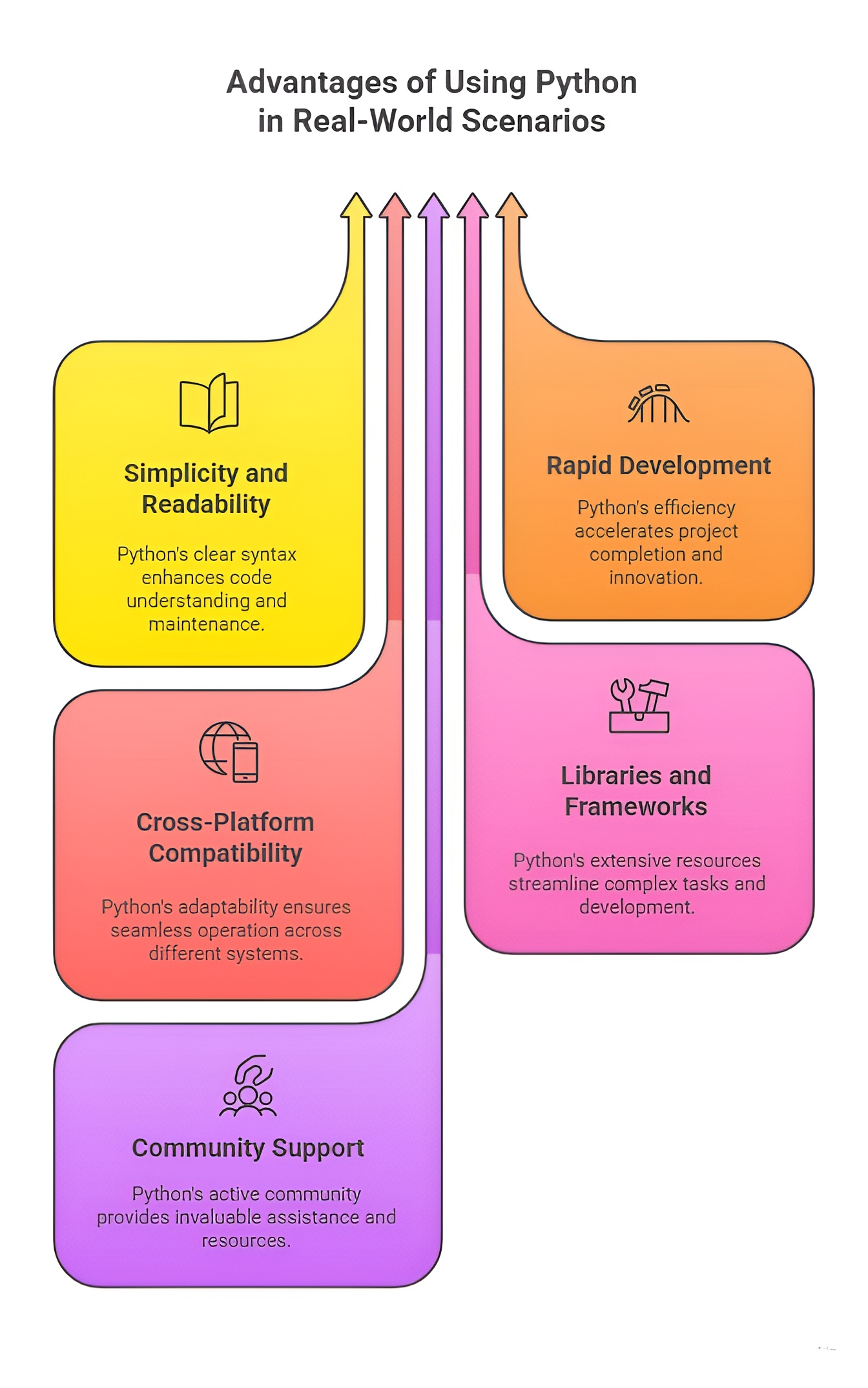
1. Simplicity and Readability
Python’s syntax is simple, intuitive, and closely resembles natural English. This simplicity reduces the learning curve for beginners and allows professionals to write clean, maintainable code. In real-world scenarios, this leads to faster development, fewer errors, and easier collaboration among teams. For example, companies like Google and NASA use Python because developers can quickly understand and modify existing codebases.
2. Rapid Development
Python enables rapid prototyping and development due to its interpreted nature, dynamic typing, and extensive libraries. This advantage is particularly valuable in industries like fintech or e-commerce, where solutions need to be developed and deployed quickly. Frameworks such as Django and Flask further speed up the creation of web applications, APIs, and backend systems.
3. Cross-Platform Compatibility
Python is platform-independent, allowing the same code to run on Windows, Linux, or macOS without modification. This ensures consistency in applications across different environments, which is crucial in multinational organizations, cloud platforms, and large-scale software solutions.
4. Wide Range of Libraries and Frameworks
Python’s rich ecosystem of libraries and frameworks accelerates development in diverse fields. For instance, data scientists rely on Pandas and NumPy for data analysis, AI engineers use TensorFlow and PyTorch for machine learning, and cybersecurity experts use Scapy and Nmap for network testing. This reduces development time and increases reliability.
5. Strong Community Support
Python has one of the largest global programming communities. This extensive support network provides tutorials, forums, open-source tools, and troubleshooting resources. Real-world projects benefit from this because developers can quickly find solutions, adopt best practices, and keep up with modern trends in technology.
6. Flexibility and Scalability
Python’s ability to support multiple programming paradigms—procedural, object-oriented, and functional—makes it flexible for a variety of applications. Companies can start with small scripts for automation and scale them into full-fledged enterprise solutions, like web applications, AI models, or scientific research platforms.
7. Automation and Productivity
Python is widely used to automate repetitive tasks, including data entry, report generation, web scraping, and testing. Automation reduces manual effort, increases efficiency, and minimizes human error, making organizations more productive. DevOps teams use Python scripts for configuration management, continuous integration, and deployment pipelines.
8. Integration Capabilities
Python integrates easily with other languages, technologies, and platforms, including C, C++, Java, and .NET. It can also interact with web services, APIs, and databases. This makes Python an ideal choice for companies looking to integrate legacy systems with modern applications.
9. High Demand in Industry
Python’s versatility and ease of use have made it one of the most in-demand programming languages in the job market. Industries like AI, data science, web development, cybersecurity, finance, and gaming rely heavily on Python. This ensures that skills in Python are highly valuable for professional growth and employability.
Importance of Python in Programming Field
Python holds a unique place in the programming world due to its combination of simplicity, power, and versatility. It serves as a bridge between beginners and professional developers, allowing learners to grasp core programming concepts without being overwhelmed by complex syntax. Its widespread adoption in emerging technologies like artificial intelligence, machine learning, data science, and cloud computing has made it essential for modern software development. Python’s cross-platform nature, rich libraries, and frameworks allow programmers to solve real-world problems efficiently, from web applications to scientific simulations and financial analysis.
1. Beginner-Friendly Language
Python’s simple, readable, and intuitive syntax makes it an ideal language for beginners. Unlike low-level languages or complex syntaxes like C++ or Java, Python allows new programmers to focus on understanding programming concepts rather than memorizing complex rules. This importance is especially seen in education, where Python is the first language taught in schools, colleges, and universities, helping students build a strong programming foundation.
2. Facilitates Rapid Development
Python enables developers to build applications, scripts, and prototypes much faster than many other languages. Its interpreted nature, dynamic typing, and rich standard library reduce the amount of boilerplate code and allow quicker testing and deployment. This makes Python indispensable in industries like e-commerce, fintech, and healthcare, where time-to-market is critical.
3. Supports Multiple Programming Paradigms
Python’s ability to support procedural, object-oriented, and functional programming makes it highly versatile. Developers can choose the paradigm that best suits the project, whether it is small automation scripts, large enterprise applications, or advanced AI models. This flexibility increases Python’s importance in diverse real-world applications.
4. Essential for Modern Technologies
Python is the leading language in modern technological fields such as Artificial Intelligence, Machine Learning, Data Science, Robotics, Cloud Computing, and Cybersecurity. Its extensive libraries and frameworks allow developers to implement complex algorithms and solutions with efficiency. For instance, TensorFlow and PyTorch are widely used for AI, while Pandas and NumPy are essential for data analysis, demonstrating Python’s critical role in advancing technology.
5. Promotes Code Readability and Maintainability
Python emphasizes readability and clean code, which is extremely important in professional programming. Readable and maintainable code reduces errors, simplifies debugging, and makes collaboration easier for large development teams. In enterprise environments, this ensures that software projects can be updated and maintained efficiently over time.
6. Cross-Platform and Integration Capabilities
Python’s platform independence allows programs written in Python to run on Windows, Linux, macOS, and other platforms without modification. Its ability to integrate with other programming languages, APIs, and databases makes it a versatile choice for companies looking to connect legacy systems with modern applications, increasing its importance in enterprise software development.
7. Strong Industry Demand
Python’s versatility, ease of use, and applicability in emerging fields make it one of the most in-demand programming languages worldwide. Industries ranging from IT, finance, healthcare, and research to AI and web development rely heavily on Python. Its importance is reflected in the high employability and career opportunities for Python developers.
8. Encourages Innovation
Python allows developers to focus on solving problems rather than dealing with complex syntax. This enables rapid experimentation and innovation, whether in AI research, scientific computing, robotics, or startups developing web applications. Its simplicity combined with power allows programmers to bring ideas to life faster, fostering creativity and technological advancement.
In essence, Python is important because it bridges the gap between ease of learning and professional capability. It is beginner-friendly, versatile, and efficient, making it critical for rapid development, integration, and implementation of modern solutions. Its use in emerging technologies like AI, data science, and automation highlights its pivotal role in shaping the future of programming and software development. Python’s readability, maintainability, and strong community support ensure that it remains not only relevant but also indispensable in both educational and professional programming environments.

Class Sessions
1- Introduction to Python
2- Basic Syntax and Variables
3- Basic Input & Output
4- Control Flow Statements
5- Lists
6- Tuples
7- Dictionaries
8- Sets
9- Strings
10- Functions
11- Modules
12- Packages
13- Introduction to Object Oriented Programming
14- Exception Handling
15- Introduction to File Handling
Sales Campaign

We have a sales campaign on our promoted courses and products. You can purchase 1 products at a discounted price up to 15% discount.