USD ($)
$
United States Dollar
Euro Member Countries
India Rupee
د.إ
United Arab Emirates dirham
ر.س
Saudi Arabia Riyal

Evolution and Career Scope in Data Analytics

Lesson 2/51 | Study Time: 15 Min

Data analytics has evolved dramatically over the last few decades, transforming from simple data collection and basic statistical reporting into a sophisticated field leveraging advanced tools, technologies, and methodologies.

This evolution is closely tied to the exponential growth of data generation, advances in computing power, and the development of machine learning and artificial intelligence.

Evolution of Data Analytics

The journey of data analytics can be understood through key stages reflecting technological and methodological progress:


1. Early Data Management: Initially, data handling focused on manual record-keeping and paper-based statistics. Early computing systems enabled basic data storage and rudimentary analysis.


2. Database Era: The advent of relational databases in the 1970s enabled structured data storage and querying using SQL, laying the foundation for modern data management.


3. Business Intelligence (BI): In the 1990s and 2000s, BI tools emerged to help organisations generate reports, dashboards, and perform basic trend analysis, focusing mainly on descriptive analytics.


4. Big Data Revolution: With the rise of the internet, social media, and IoT, data volume, variety, and velocity exploded in the 2010s. Big data technologies like Hadoop and Spark enabled the processing of massive datasets.


5. Advanced Analytics and AI Integration: Today, data analytics integrates predictive and prescriptive models using machine learning and deep learning, unlocking deeper insights and automation. Cloud computing and self-service analytics platforms democratize access across organisations.


This evolution has shifted data analytics from a back-office function to a strategic asset critical for innovation, competitive advantage, and operational excellence.

Career Scope in Data Analytics

The career landscape for data analytics professionals has expanded rapidly to include a wide spectrum of roles across industries. The demand is driven by organisations seeking expertise to harness data's full potential.


1. Key Roles in Data Analytics:
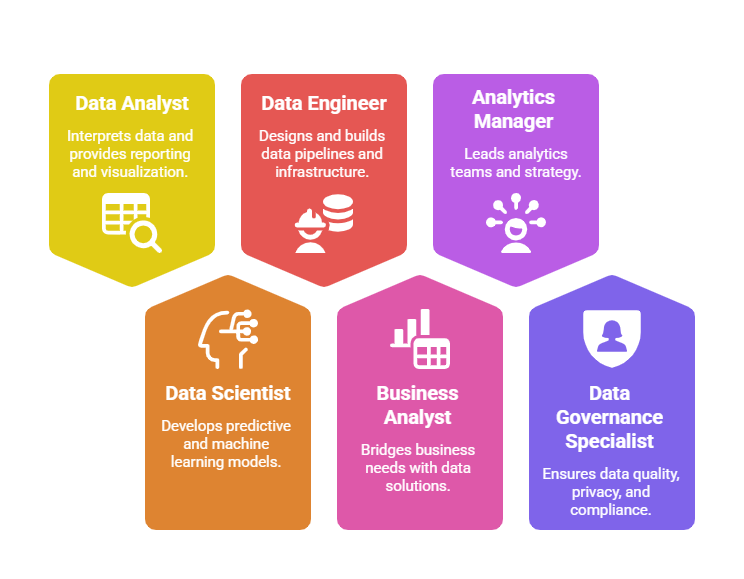
2. Industry Applications: Finance, healthcare, retail, manufacturing, technology, government, and marketing heavily rely on analytics for risk management, customer insights, operational efficiency, and regulatory compliance.


3. Skills in Demand: Proficiency in statistical analysis, SQL, data visualization, Python or R, machine learning, and cloud platforms are widely sought. Soft skills like communication and stakeholder management are essential.


4. Emerging Trends: The rise of AI-powered analytics, real-time data processing, augmented analytics, and edge analytics opens new frontiers. Roles increasingly require cross-functional collaboration and business acumen.

Evan Brooks

Evan Brooks

Product Designer
Profile

Class Sessions

1- Understanding Data Analytics and Its Business Value 2- Evolution and Career Scope in Data Analytics 3- Types of Analytics: Descriptive, Diagnostic, Predictive, and Prescriptive 4- Data-Driven Decision-Making Frameworks 5- Business Analytics Integration and Strategic Alignment 6- Data Sources: Internal, External, Structured, and Unstructured 7- Data Collection Methods and Techniques 8- Identifying Data Quality Issues and Assessment Frameworks 9- Data Cleaning Fundamentals: Removing Duplicates, Handling Missing Values, Standardizing Formats 10- Correcting Inconsistencies and Managing Outliers 11- Data Validation and Quality Monitoring 12- Purpose and Importance of Exploratory Data Analysis 13- Summary Statistics: Mean, Median, Mode, Standard Deviation, Variance, Range 14- Measures of Distribution: Frequency Distribution, Percentiles, Quartiles, Skewness, Kurtosis 15- Correlation and Covariance Analysis 16- Data Visualization Techniques: Histograms, Box Plots, Scatter Plots, Heatmaps 17- Iterative Exploration and Hypothesis Testing 18- Regression Analysis and Trend Identification 19- Cluster Analysis and Segmentation 20- Factor Analysis and Dimension Reduction 21- Time-Series Analysis and Forecasting Fundamentals 22- Pattern Recognition and Anomaly Detection 23- Relationship Mapping Between Variables 24- Principles of Effective Data Visualization 25- Visualization Types and Their Applications 26- Creating Interactive and Dynamic Visualizations 27- Data Storytelling: Crafting Compelling Narratives 28- Narrative Structure: Problem, Analysis, Recommendation, Action 29- Visualization Best Practices: Color Theory, Labeling, and Clarity 30- Motion and Transitions for Enhanced Engagement 31- The Analytics Development Lifecycle (ADLC): Plan, Develop, Test, Deploy, Operate, Observe, Discover, Analyze 32- Planning Phase: Requirement Gathering and Stakeholder Alignment 33- Implementing Analytics Solutions: Tools, Platforms, and Technologies 34- Data Pipelines and Automated Workflows 35- Continuous Monitoring and Performance Evaluation 36- Feedback Mechanisms and Iterative Improvement 37- Stakeholder Identification and Audience Analysis 38- Tailoring Messages for Different Data Literacy Levels 39- Written Reports, Dashboards, and Interactive Visualizations 40- Presenting Insights to Executives, Technical Teams, and Operational Staff 41- Using Data to Support Business Decisions and Recommendations 42- Building Credibility and Trust Through Transparent Communication 43- Creating Actionable Insights and Clear Calls to Action 44- Core Principles of Data Ethics: Consent, Transparency, Fairness, Accountability, Privacy 45- The 5 C's of Data Ethics: Consent, Clarity, Consistency, Control, Consequence 46- Data Protection Regulations: GDPR, CCPA, and Compliance Requirements 47- Privacy and Security Best Practices 48- Bias Detection and Mitigation 49- Data Governance Frameworks and Metadata Management 50- Ethical Considerations in AI and Machine Learning Applications 51- Building a Culture of Responsible Data Use
